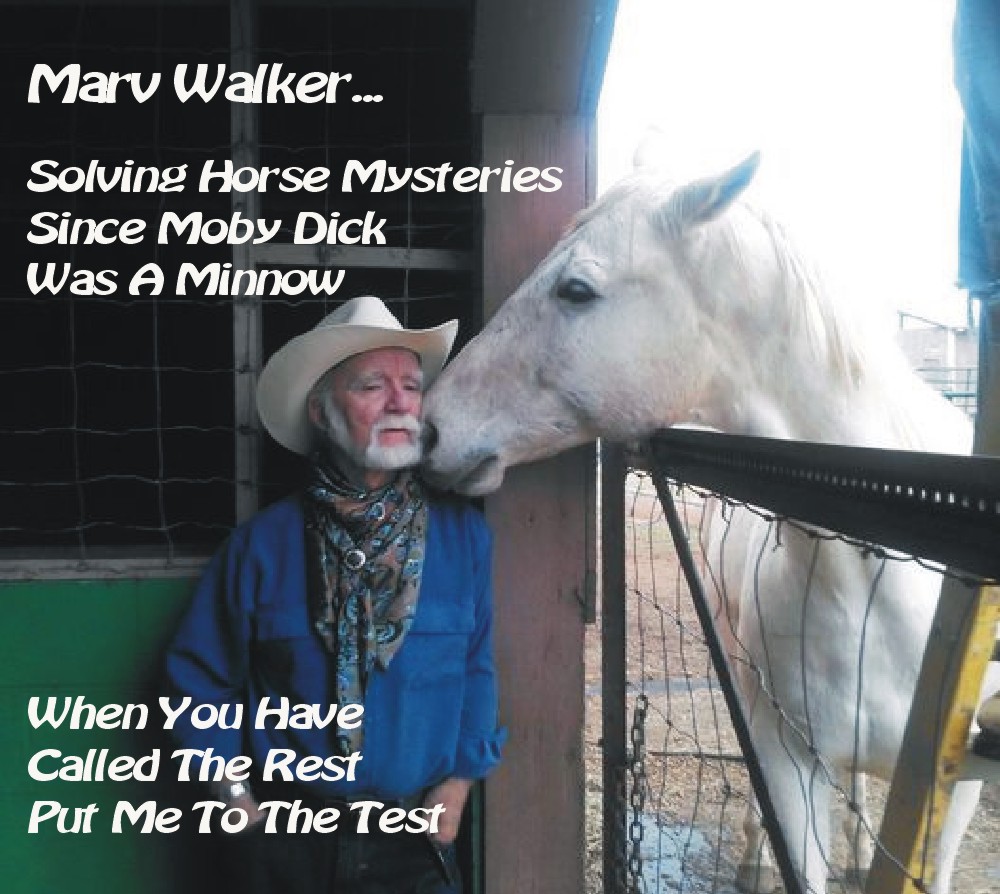

This is my report of my very first clinic held in Madison, GA. in November of 1998.
Earlier in the summer of '98 a half century or so of monkeying with horses joined with a couple of discoveries and I suddenly had the ability to form a mental connection with horses in minutes instead of the days, weeks and years it had taken me before that point.
The "Horse Whisperer" media fad was in full bloom then and I was contacted by a reporter who did a very in-depth article about my abilities. About that time I started making a few suggestions to folks with horse problems on a couple of horse topic Internet discussion lists I was on.
Next thing you know people from all over the world are contacting me for my suggestions about their horse problems.
I received a few requests for clinics and November 1998 was my first.
I was incredibly flattered at the distances people traveled to take part.
Here is *MY* interpretation of the clinic, perhaps others who were there have a different take or something else to offer. If so, I'll be glad to post their report here on the site as well.
This clinic was my first formal clinic and it was intended as much as a learning experience for myself as it was to help people learn how to mentally connect with their horses and use that connection to get past problems and/or deepen their communication with them.
For those of you who know me, and those who may not have figured it out yet, I am not the least bit afraid to mention my talents and abilities and am perfectly willing to have those talents tested and challenged at any time. I operate on the principle of, "If it's fact it's not bragging," and "If you deny, downplay or demean your talents and abilities you are in effect lying." In other words, I'm et all up with confidence. Whether it's justified or not may very well be a matter of discussion.
When it comes to horses, I really know very little. But in 47 years (at the day this page was put up) of loving them and for some strange reason always coming into contact with the scamps has taught me more about horses than the average person.
This lifetime of learning has evolved into a system of dealing with horses that added to my insufferable confidence, enables me to say something few other horse trainers say, "If AFTER I have performed the work, you do not think I am worth the money I charge, I will cheerfully refund." No results...no pay.
And everyone who walked into that arena that day had that guarantee. No one asked for, or even acted like they wanted their money back even though I made sure it was understood by all from the get go...THERE WAS NO RISK. It was satisfaction guaranteed. Period. Some left early on the second day saying they already had what they came for. One auditor spent part of Saturday then left. She called me a few days afterward to ask for clarification on a point and in the course of the conversation she told me she was totally blown away by what she had learned and what a difference it made in her horses. I said all that to say, that the fact everyone seemed to be satisfied was in itself enough for me to consider it a success.
I had 12 participants and 12 horses, two more of each than I planned for. Each participant was able to perform the bonder to a successful conclusion. Each completion wasn't nearly as cut and dried as they would of been had I been performing them and not stopping to comment, point things out, answer questions and dealing with all the other distractions involved in the setting. However, considering the participants were new to the concepts, trying to figure out their own movements in addition to processing the horse's movements and all the other distractions involved in the setting, they all did exceptional.
In the hassle of learning the participants may not have fully noticed the results but they were there. A couple more sessions at home and they will be jam up bonders.
About half of the participants came off the Internet, half came from an ad I placed in a magazine read only by those who were looking to sell or buy horses. A third of the total came from out of state, some from as far away as Michigan to Georgia. Since I stressed the value of my techniques with problem or annoying horses, for the most part, that's what I got.
At 8 o'clock on Saturday morning I found myself facing 12 horses AND 12 participants and a small number of auditors who were expecting results and a 2 day whirlwind wing-it began. What ever popped up, what ever happened got dealt with.
It never occurred to me that I'd need to keep notes as I went. It should have but I didn't. I went from horse to horse so fast, they tended to blur into each other. As soon as one horse was done and another came in, I'd pretty much forget what was discovered and accomplished with the horse before as I concentrated on the new horse to come in the enclosure. As a result, when I was working a horse I'd worked before, I often had to ask what I had done with it before. Now, a few days later, they still blur. And that's not good for a clinician. That will be corrected at future clinics.
One mare prior to the clinic had to be twitched, scotch hobbled, tranquillized and fought for shoeing and her owner had said forget putting on a slicker anywhere near her. The owner had a cast on her leg from a recent injury so I picked an auditor to take the owner's place. The mare went through the bonder as expected even with the operator uncertainty and at the completion of the bonder I went in and asked if anyone had a hammer. A hammer, a farrier's hammer even, was produced by the owner which I thought was odd considering the horse had a shoeing problem. With the mare untied I bent down picked up a hoof and making no effort to be gentle, pretended to be a farrier. She stood while I whacked, hammered and dug with no problem. It was the bonder that made her accept it, not any training.
A little while later I heard hammering on shoes coming from her stall and then I saw her owner coming out with a big smile and saluting me with the hammer. When I came back from lunch, I found the mare and her owner in the pen and the mare had the slicker around her head acting like it was no big deal. The owner thanked me for the change, but in reality, she did it all herself by having the mare put through the bonder. The bonder / herd dynamics procedure set the stage for going on and made the mare MUCH more trusting in minutes.
One participant brought a 2 1/2 year old TWH stud colt that he wanted to get a saddle on. He was a big guy and this was a small horse and I explained it was not anywhere near big enough or old enough to be ridden him. He agreed and told me he had no intention of doing that, merely getting him to carry a saddle. His problem was the horse would not allow the saddle ANYWHERE near him, he simply went nuts according to his owner.
This was one feisty colt, he reared, struck out and kicked out from the get go. His person was somewhat unnerved by the intensity of the aggression from a distance while the spectators oooh'd and awww'd but with a little guidance got the bonder going along. When the bonder was completed, I brought the saddle in and in a minute or so the horse was saddled and carrying it around like it was no big deal. The owner left the pen and took the horse to the obstacle area I had set up for testing and enhancing the connection and worked him there.
A couple of hours later I was working another horse and participant combo when I glanced up and saw the little TWH being led from the stall area toward the trailers. In a few minutes I heard someone say, "Look at that!" I looked up to see the horse being led back in nonchalantly wearing his saddle. To go from a horse that wouldn't tolerate a saddle in his proximity to one that could be saddled at a trailer alongside a busy highway in less than an hour tops with no problems or anxiety was quite pleasing to his owner.
When he left to go home early saying he'd gotten what he came for he asked for loading help because he was afraid the horse wouldn't load easy. Well, maybe he wouldn't pre-bonder but he sure did after. That little horse was a listening fool the last time I saw him.
Probably a third of the horses showed ill-tempers. One, a *HUGE*, read HUGE here people, Oldenburger tried eating me for lunch when I first walked up to his stall to look at him after he was unloaded when he'd arrived the night before. His owner reported that the FIRST thing she did was get his halter on him and then he became more manageable but even at that she took great pains around him and walked on eggshells. She said that when she first bought him a few years ago he grabbed her and flung her over the stall wall.
To my great surprise the bonder didn't do much for him. He displayed a somewhat better demeanor out of the stall but not a lot of improvement in the stall. Later on while talking to his owner I told her this can happen with horses who are INTENSELY afraid of everything. Basically they are like bullies in a school yard who are so frightened someone may do something to them they make preemptive strikes...kind of a "do unto others BEFORE they do unto you" mindset. If you confront this type of bully he usually tries the "let's be buddies" approach of removing the concern, after all no one picks on their buddies as a rule. I suggested confronting him.
She had difficulty believing such a huge animal could be such a fraidy cat and in effect told me she was willing to confront him but that was easier said than done as she motioned me toward the stall door. I got a Linda Tellington-Jones whip, which she calls a "wand," and held it so the knob was up and stepped through the stall door. I saw his ears go back and as he whirled to get me I thumped him on the bridge of his nose and loudly told him, "NO!"
That stopped him instantly. Surprised, he looked at me for a split second then quicker than a cat, he whirled and set me up for mule kicking. Even though I had left an escape open, when that truck-sized butt backed up to me I had no time to step back as he began kicking and his feet were missing me on each side. Whenever that hind end lowered to get momentum I rapped him sharply on the butt and yelled, "NO!" Three sharp raps, three "NO!s" and he spun back around and acted like he didn't know what my problem was. After a few moments I stepped out of the stall. I waited a bit then went back in the stall, he looked at me, pinned his ears slightly but made no effort to go for me.
His owner was quite impressed and I invited her in with us and we stood there discussing our new attitude as he pretty much ignored our presence. I suggested she get it in her head *she* owned the stall and she *lets* him use it.
Later on I saw him laying asleep in his stall and I went in. He didn't open his eyes. I stood beside him and scratched him and then he opened his eyes, looked at me and then closed them again. I called his owner and we went back into the stall, and again, he paid little attention to us being there.
By the time she left he was a different boy temper wise. She fed him without a halter, petted him as he was eating, picked his stall, walked around him and let him get between her and the door and he showed no aggression. But when ridden, he still locked up, bucked and refused to go forward freely when legs were put on him. I couldn't find any reason for him to act like he was in pain. That never means there *ISN'T* any pain, it only means that I can't find it.
Then I remembered her reaction when he slung her over the stall wall. She said she lost it. He had hurt her feelings and she was mad and she grabbed a plastic apple picker and went at him for a couple of minutes. She said when she finished there was frothy red blood coming from his nostrils. She thought he had banged his nose on the wall because she had been careful to whack his butt even though she was mad.
As a rule, frothy red blood comes from the lungs. Some horses, especially race horses, have a condition called "exercise induced hemorrhage." The vessels in the lungs rupture under exercise and the horse sometimes bleeds enough to have it come out the nostrils. I recommended a complete veterinary examination including chiropractic & endoscopy because I'm convinced he was in pain. She also said there is no consistency as to the length of time he'll go while working before he balks. It's possible he goes until the discomfort in his lungs becomes too great to keep going freely.
Aggression can have a physical cause as well as a fear and disrespect cause. If a horse is in pain, it will not want to work or cooperate any better than a human will under pain.
Another ill-tempered Oldenburger-Paint had a bucking, rearing and just generally inconsistent behavior. His attitude seemed somewhat better after the bonder but not anywhere near what I would have expected. When he came back into the pen for an under saddle session I immediately noticed a weird dip in his lumbar region. Why I hadn't noticed it before I have no idea but as he passed in front of a light colored sign panel on the wall I saw it in his silhouette. Upon closer examination I noticed he had several lumbar vertebrae out of position. And as I looked at him I noticed he had a number of cervical vertebrae out as well. My horse partner at the time also discovered he had a shoulder out and stifle problems. I have not seen one that bad in a long time.
As I pointed out these things one after another, the owner remarked angrily, "These things are so obvious!! Why didn't the vet see them??!!" Nothing against vets but these things are beyond what most vets see in their practices and they don't notice them. Naturally, I recommended having him looked at by an equine chiropractor which his owner assured me was going to happen.
Turns out the horse had backed off a bridge in her yard. I thought it was a lot of damage from simply backing off a trail prop but stranger things have happened.
A few months later on a trip up into the Carolinas the owner asked me to stop by for lunch on my way by. As I was looking through a stack of photographs of the horse and her place I discovered that the bridge he'd backed off of was NOT the little trail training bridge I first thought it was. She had an actual car bridge over a creek just off her front yard. And I also discovered she had a similar bridge off behind the house over the same creek and he had backed off BOTH bridges within a short time period. It looked to be a ten foot drop to the creek bed, "We had the vet out and he couldn't find anything."
No amount of bonding will make a horse who has gone through that sort of thing a cream puff. A horse in that condition simply cannot be expected to be cooperative. His owner told me his riding days were over until he was certifiably sound. When even half of his problems are corrected, he will be a different horse.
While we're on the subject of aggression and pain there was another horse who had little respect for his owner who was an 8 month or so horse person counting time to recuperate from a broken back suffered when the horse shot up from under her after being hit by a blowing plastic bag. When she performed the bonder she was engrossed in *her* positioning she missed the success signals he was giving. I went in the pen and stopped his owner and putting my arm across her shoulders guided her away from the horse. As soon as her back was turned the horse quickly approached and followed.
But the aggression in the stall continued pretty much unabated which, sing along here, greatly surprised me. I then decided I'd use him as a despooking example to drill the bonding in him a little deeper and because I had reason to suspect he was super spooky. I went at him with a plastic bag on the end of a longe whip and a 10 minute or so exercise stretched into about a half hour with only minimal success. I sent him back to the stall so I could regroup. Later when I went back to deal with his stall aggression I noticed several bulges on the side of his neck. They were so obvious, I was stunned that I had overlooked them. When I looked at the other side I saw more bulges. Again, here was a horse in pain, but for a few relatively minor vices was fairly well behaved for the most part.
When horses with vertebrae out place are corrected there is almost always an immediate improvement in demeanor and temper. When the subluxations are properly aligned again, the horses are MUCH less flighty, spooky and aggressive.
If a horse habitually pays no attention to you, stands in your space, does what it wants to do, is stubborn and generally resistant and you have the feeling the horse just doesn't give a hoot whether you are there or not, it is quite often a respect issue.
If a horse is ill-tempered, inconsistent, jerky, spooky and defies all efforts to successfully accomplish at least half of what you are trying then the chances are good you have a pain issue. You may also have some respect problems, but pain is almost certainly your main concern. Get the pain dealt with and if the problem doesn't disappear, it will be easier to deal with.
One participant had a standing still while mounting problem AND a backing problem in addition to cervical problems. I directed her to take him to the center of the pen and mount. If he moved away send him out for a couple of bonder reaffirmation laps and then bring him back and try it again. When he stood after a couple of times she demonstrated his backing...or rather she demonstrated his ability to back away from an annoyance. She pulled the reins back firmly and held them while verbally telling him to back. The snaffle pinched his jaws apart, the reins tucked his chin and htper-flexed his neck. After several of these pulls, he'd finally just back out of the flex. The horse never learned to back from the ground on any kind of cue. If a horse won't back properly from the ground, it probably won't back correctly from the back.
I didn't get to get into the subject of mouths as much as I would have liked to, which is another thing I'll correct in future clinics. But I was able to find wolf teeth in a number of the horses. Some of the participants were surprised to find them, others said they were told there was no problem because they were still below the gum line; some said their practitioner merely nipped them off; some said they were told the bit wouldn't reach them; and some said they had them removed even though they were still there.
When it comes to wolf teeth, *I* want them REMOVED. I don't want them chipped off even with the gum line, left alone if they can be felt even though they have not erupted or just casually twisted out without verifying they are indeed gone. Am I absolutely certain they will cause a problem if left alone? Nope. Not at all.
I am relatively certain that if they are gone they won't cause a problem. No banging with a bit, no tender gums, no jagged remnants left to cause potential pain.
While we are on the mouth subject one of the attendees showed me a snaffle bit that had about 8 copper filled saw grooves on each side. I licked it to get an idea of how to describe the taste, if any. I found nothing unusual about the bit as far as taste goes. I held it while I explained the rational behind copper bits and then we broke for lunch.
At Wendy's my hand started itching and I looked at it and I saw a welt in the form of the bit complete with a circle the same size as the one where the bit was joined. Back at the clinic, I was able to show my hand to a number of people before the welt went away. I wonder how many horses who are given copper bits have a reaction to them. Another horse there had a German Silver allergy that caused mouth ulcers. If you feel your bit is causing you problems, check the teeth and the metal.
I figure what I do with horses is not rocket science. I look at it more as horse forensics. I try to uncover as much as I can about the problem, push it against what I have learned over the years, and mix it all together with a good dose of gut feeling and impressions I get from the horses and the people, then go from there.
I have a long string of successes. No brag, just fact. If you, and I'm speaking general "you" here, are objective and can gather enough information, you can usually make some staggering progress. I am certain I can teach practically anyone who wants to learn how to do it.
For Further Information Contact Marv Walker 706 816-7190 Evenings 9 to 12 PM
Questions, comments or suggestions
Back to Marv Walker's Index Page