
Only Gets On The Bit For A Few Seconds
The gist of how it started was the phone call from several hours away...
"As soon as I arrived home from your clinic I went right to the barn and looked at my mare and just like you said, I discovered several vertebrae out of place in her neck. I'll bet that's why I can't get her on the bit for more than a few seconds."
"We have to have our chiropractor / vet out for our own horses, bring her down and he can look at her too," I replied.
Lucy, a 14 year old, good sized, Quarter- Appendix mare arrived at Daymark riding in a tall two horse bumper pull. Unloading, she backed nonchalantly and unconcerned from the trailer until her back legs hit the ground and then it was desperate scrambling to get out. One moment, unconcerned, the next, as soon as her weight shifted to her hind quarters she was scrambling. Once free of the trailer she was immediately unconcerned again.
That indicates hip problems. Horses skeletal structures are optimally designed to withstand gravity straight down. Gravity is a force directed through all objects toward the center of the earth. It is a downward force. The force of gravity is propped up on the skeleton. When you change the horse's relationship to the horizon, such as when it is exiting a trailer, the force of gravity is directed at an angle to the support. In a horse with no hip problems this change in the gravity direction goes pretty much unnoticed.
See the difference here? If a horse starts scrambling in the trailer when all of his feet are on a level plane, it's usually a fear problem. If the horse casually backs up then has a momentary scramble when the angle of his body changes and then becomes immediately casual again, it's usually a hip problem.
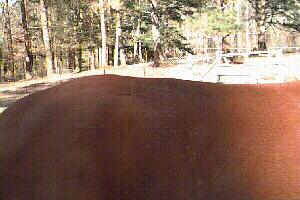
I then noticed a "tenting" in the lumbar region which confirmed my suspicions. I see this in horses who have been jammed from the rear end. Sitting down while rearing, backing off bridges and embankments, or just being run into by another horse, can cause this. It can also be cause by horses hopping over jumps instead of jumping over jumps. This is why I see this in a high percentage of jumpers and hunters. This is what I call a "hunter's hump" or "jumper's bump." More accurately, it is a sacroiliac strain. When a horse has this condition it is difficult, if not impossible, to come up under itself for any great length of time.
I watched the mare walk and saw a bit of a hind leg swing. Like a very faint windmilling and she swung her legs out and around to set them down. She was very lame. Not obviously lame to someone who was around her everyday or someone who does not see a lot of lameness, but she was very lame. There was also a strange clicking sound that seemed to come from the area above her stifle.
In my work with horses I find that lame is lame. Many horse people think limping is lame. See what I'm saying here? They feel, if the horse is not obviously limping, it is not lame. I feel, if there is noticeable, to me, restriction in the horse's leg movements it is lame. Maybe not dead lame, but lame none the less. Which is why when I get around quarter-horse shows I see so many lame animals.
As I went around the front of the horse I noticed a number of scars which the owner said were wirecuts, according to what the previous owners told her. I did find vertebrae out and was surprised at her disposition in spite of the amount of problems she was obviously having in her neck.

I continued my tour around the horse and came to her hind quarters. As you can see from these pictures, it wasn't pretty. I also saw immediately that the mare's vulva was distorted and abnormally small. I asked the owner, "What happened to this horse??!"
One of the things I don't mention a whole lot because people wig out when I say it. I get mental images from animals and some people. It is a learned skill, nothing freaky or mysterious, just being aware it can happen and being open to it with a discerning mind. The animals don't say things like, "Going to the store? Don't forget you're out of milk." The communication comes in as scenes and images, more like eavesdropped thoughts and you have to decide if they mean anything.
Anyway, just as the owner said she had no idea, it happened before her, I suddenly got this mental picture of a box pushing in from the back. I looked at Kellie Sharpe, my horse partner at the time who also has learned the skill of communication and we said in unison, "Trailer wreck!"
Do we know this for sure? No. Images aren't all that specific. You have to put them with what you know and then you often come up wrong. But a rear-ended trailer was the only thing that fit the problems I saw on the mare.
As we waited for Dr. Hooten to arrive a discussion about breeding was started by the owner. When we expressed doubt that it was wise to breed this mare due to her hip condition and the size & deformation of the mare's vulva, not to mention the obvious discharge scald on the back of the right rear hip, the owner informed us the mare was examined by a vet who said he saw no problem with breeding. Maybe vet school would help me, because *I* sure saw a problem.

When Dr. Hooten arrived he looked at the mare's vulva and also questioned whether breeding was an option. He said, at the very least, the discharge scald needed investigating. The owner then expressed that the vet had checked her and pronounced her okay. Sometimes a second opinion is called for. Ooops. I mean, third opinion, mine's usually the second and I really don't know all that much.
He concurred with the lameness and decided to deal with that first. He performed a series of lameness checks on the mare's left hind leg. He held the hoof angled back as far as it would go at the pastern for two minutes then dropped the hoof and had the horse immediately trotted off. No change. He then held the leg up toward the stomach for two minutes and the horse was trotted off. No change. Then he held the fully extended leg angled as high as he could out to the side. When she was trotted off, major limping. He repeated the tests with the other hind leg. Same results.
The lameness tests tested three areas of the leg, ankle, hock & hip joint. Since increased lameness showed itself with both hip joint lameness tests, these results, when added to the peculiar walk and obvious loin & hindquarter muscle pain reaction to light palpation, caused Dr Hooten to feel the mare had a condition similar to hip displaysia in dogs.
He then laid out for the owner several courses of treatment that were designed to verify by the results whether his conclusions were valid. Each of these treatments had cost & time considerations for the owner. He felt that the condition was for the most part, not curable by chiropractic, because of its advanced state.
Not being a vet I kept my mouth shut, but the sight of the horse's hind end told me that at one time she had taken a very strong hit in the hind quarters which would almost certainly jam some things, possibly even fracturing bones and there are some things chiropractic cannot take care of.
*IF* she had been jammed in a trailer wreck that would also explain the "wire cuts" on her chest.
Chiropractic can often *help* and so we took her into the barn yard for some adjustments. Dr Hooten adjusted her neck and adjusted her back as best he could. It was his feeling that the muscle tension from the hip problem was what was causing the tenting in the lumbar region. As horses almost always do after extensive chiropractic, Lucy stood quietly and unmoving as if on the verge of sleep.
As we watched her eyes closed and her head sank and her knees buckled. She awoke and caught herself but it was strange to see. As we watched she did it repeatedly. Dr Hooten and I looked at each other at the same time and the owner said, "She does that all the time. She'll even do it while being ridden. Once, she just went down under me."
Narcolepsy is a very rare condition in horses. But I was convinced we were looking at a narcoleptic horse. Dr. Hooten explained there are ways to verify narcolepsy but it was decided it wasn't feasible for Lucy.
This case may seem like a failure. It was almost impossible for this horse to produce, because of her problems, what the owner wanted - a collectable, on the bit horse. We were unable to pull anything out of our bag of tricks to perform any magic.
We did give closure to the problem and discover conditions in the mare that, at this point in time, have no known resolutions, and can merely be coped with. This case at least has a resolution.
Click here to check out my very reasonably priced DVD inventory covering many of the subjects featured on my site's pages in greater depth.
For Further Information Contact Marv Walker 706 816-7190 Anytime.
Questions, comments or suggestions
Back to Marv Walker's Index Page